Heating & Lighting
Reptile Heating and Lighting Explained for Beginners
Learn how to set up reptile heating and lighting correctly — heat sources, UVB, thermostats, gradients, and photoperiod explained for first-time keepers.
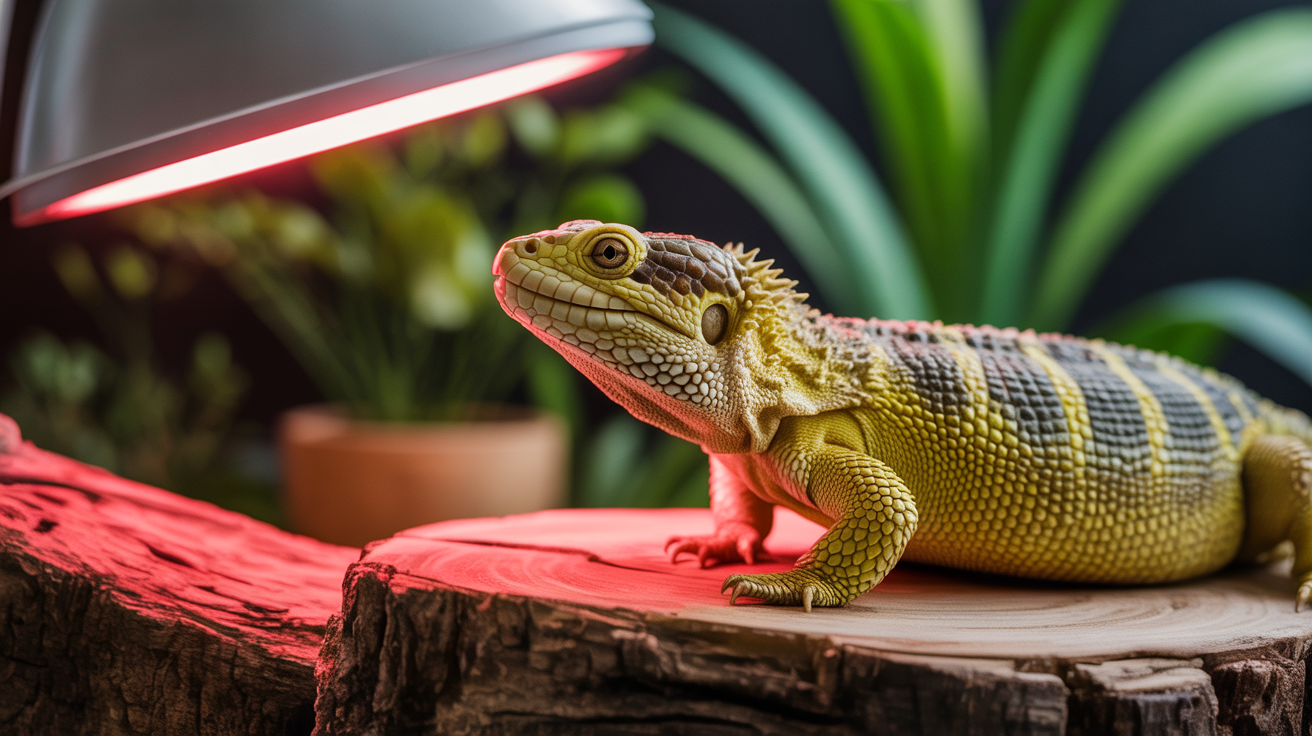
Getting heat and light right is the single most important thing you can do for a captive reptile. Most beginner problems, refusal to eat, lethargy, metabolic bone disease, respiratory infections, trace back to an enclosure that is too cold, missing UVB, or running on the wrong cycle. This guide walks through every piece of the system, why it matters, and how to set it up without guesswork.
Why Reptiles Need Precise Heat and Light
Reptiles are ectotherms. Their body temperature is not self-regulated the way a mammal's is; they borrow heat from the environment and move between warm and cool zones to manage their internal processes. Digestion, immune function, hormone cycles, and even color vision depend on hitting the right temperature range for the species.
Light matters for a different reason. Ultraviolet-B radiation (UVB) triggers synthesis of vitamin D3 in the skin, which controls calcium metabolism. Without adequate D3, calcium cannot be absorbed from food properly, and the skeleton and organs pay the price. This is why metabolic bone disease is so common in captive lizards kept under standard household lighting.
Heat and light also work on separate schedules, and many beginners conflate them. A basking bulb provides both visible light and heat during the day. A ceramic heat emitter provides heat only, with no light. Getting the timing and intensity right for each requires some planning.
Heat Sources and What Each One Does
| Equipment | Purpose | Notes |
|---|---|---|
| Basking bulb (incandescent/halogen) | Focal hot spot for daytime basking | Position above the basking surface; adjust wattage until temps are correct |
| Ceramic heat emitter (CHE) | Radiant heat, no light | Use at night or to supplement ambient temperature without disrupting the photoperiod |
| Deep heat projector | Penetrating infrared (IR-A/B) | Mimics solar infrared better than standard heat mats; good for burrowing species |
| Under-tank heat mat (UTH) | Belly heat for terrestrial/fossorial species | Must be used with a thermostat; snakes and some lizards benefit; do NOT use as a sole heat source |
| Radiant heat panel | Overhead ambient heat, no light | Common in large enclosures; requires a thermostat |
| Halogen flood bulb | Intense basking spot, efficient wattage | Often preferred over standard incandescent for the density of the hot spot |
Basking Bulbs
A basking bulb creates the focal hot spot where your reptile thermoregulates at the warmest part of the day. Choose wattage based on the distance from the bulb to the basking surface. Start with a lower wattage and work up, you are aiming for a surface temperature, not a bulb rating.
Place the bulb on one end of the enclosure so it heats only part of the space. The rest of the enclosure should remain cooler. This gradient is not optional; it is how the animal controls its own body temperature.
Ceramic Heat Emitters
A ceramic heat emitter (CHE) screws into a standard porcelain lamp socket and produces radiant heat with zero visible light. This makes it the right choice for maintaining overnight temperatures without disrupting the dark period. Many keepers leave a CHE on a thermostat all the time, supplementing the basking bulb during the day and taking over at night.
Never use a CHE in a plastic socket. They get hot enough to melt standard fittings.
Heat Mats
Heat mats deliver conductive belly heat and work well for snakes, some geckos, and ground-dwelling species that would normally absorb heat from warm substrate in the wild. They do not raise air temperature meaningfully.
The risk with heat mats is burns. An uncontrolled mat can reach surface temperatures above 120°F (49°C). Always pair a heat mat with a thermostat set to the target belly-heat temperature (typically 85–90°F / 29–32°C for most snakes) and verify with a probe thermometer taped to the mat surface under a thin substrate layer.
Setting Up a Proper Thermal Gradient
A thermal gradient means the enclosure has a warm end and a cool end, with the animal free to choose its position. Without a gradient, the animal cannot thermoregulate and is essentially stuck at whatever temperature the whole enclosure reaches.
Typical temperature ranges by category (check species-specific resources for exact numbers):
- Tropical lizards (e.g., bearded dragon, blue-tongue skink): Basking spot 100–110°F (38–43°C), cool side 75–80°F (24–27°C)
- Temperate/subtropical lizards (e.g., crested gecko): Basking spot 85–90°F (29–32°C), cool side 68–74°F (20–23°C)
- Corn snakes: Warm hide 85°F (29°C), cool side 70–75°F (21–24°C)
- Ball pythons: Warm hide 88–92°F (31–33°C), cool side 76–80°F (24–27°C)
- Tree frogs (e.g., white's tree frog): Ambient 75–85°F (24–29°C), no basking spot needed
Position the basking lamp at one end. Place hides on both the warm end and the cool end so the animal has a secure resting spot at either temperature extreme. Many keepers neglect the cool-side hide, which leaves the animal forced to bask even when it wants to cool down.
How to Measure Temperatures Correctly
Never rely on how warm the glass feels, how bright the bulb looks, or what the packaging says. Measure with instruments.
You need two tools:
- Infrared (IR) thermometer / temperature gun, point-and-click surface temperature readings. Use this to measure the basking surface, the cool floor, and the glass background. Takes seconds.
- Digital probe thermometer, accurate ambient air and substrate readings over time. Tape the probe at the level where the animal spends time, not near the top of the enclosure where heat accumulates.
Check temperatures at multiple points: basking surface, warm-side floor, cool-side floor, and warm/cool ambient air at animal height. Take readings at midday when the system has been running for a few hours.
Thermostats: Non-Negotiable for Any Heating Element
A thermostat senses the temperature in the enclosure and cuts power to the heater when the target is reached. Without one, a heating element runs at full output continuously, and the temperature climbs until something burns or dies.
Do you need a thermostat for reptile heating? Yes, always. There is no exception. Even "low-wattage" mats have killed animals by overheating in an enclosed space.
Three main types:
- On/off thermostat, simplest; cuts power when temp is reached, restores it when it drops. Fine for heat mats and CHEs. Can cause subtle temperature fluctuations.
- Pulse-proportional thermostat, sends power in pulses, reducing as target approaches. Better stability; preferred for CHEs and radiant panels.
- Dimming thermostat, smoothly reduces voltage to the heater. Ideal for incandescent basking bulbs because on/off cycling shortens bulb life and changes light levels abruptly. Do not use a dimmer thermostat with CHEs or fluorescent fixtures.
Set the probe in the area you want to control, the basking surface for basking-spot control, or the warm hide for overnight ambient control. The thermostat controls temperature at the probe location; everywhere else will be slightly different.
UVB Lighting: What It Does and How to Choose
UVB is invisible ultraviolet radiation in the 290–315 nm wavelength range. Skin exposure triggers production of previtamin D3, which converts to active vitamin D3. D3 regulates calcium and phosphorus absorption. Without it, calcium cannot move from food into the skeleton normally, leading to metabolic bone disease (MBD), soft bones, tremors, curved spine, and organ calcification.
Most reptiles that are active during daylight hours require UVB. This includes all diurnal lizards (bearded dragons, blue-tongues, chameleons, anoles), most tortoises and turtles, and many snakes. Nocturnal species (leopard geckos, ball pythons, corn snakes) can synthesize D3 from dietary sources, but many keepers and veterinarians now recommend low-level UVB for them anyway, as it supports natural behavior and immune function.
What is UVB and why does your reptile need it?
T5 vs T8 Fluorescent Tubes
| Type | Tube diameter | Output | Typical coverage | Best for |
|---|---|---|---|---|
| T5 HO (High Output) | 5/8 inch | High UVI | Up to 24 inches (61 cm) below tube | Desert species, taller enclosures, basking lizards |
| T8 | 1 inch | Moderate UVI | 6–12 inches (15–30 cm) below tube | Forest/tropical species, lower enclosures |
The Ferguson Zone system ranks reptiles by the UV Index (UVI) they seek in nature. A bearded dragon targets UVI 3–5+ in the wild; a blue-tongued skink aims for UVI 1–3; many forest geckos seek UVI 0.5–1. Match the bulb output and positioning to your species' zone. Arcadia and Zoo Med publish placement guides for their bulbs.
Glass and acrylic block UVB almost completely. If your enclosure has a glass mesh top or solid glass lid, most of the UVB is absorbed before reaching the animal. Use a fine aluminum or stainless steel mesh top, or position a T5 HO inside the enclosure directly.
UVB output declines over time even if the bulb still glows visibly. Replace T5 HO bulbs every 12 months and T8 bulbs every 6 months, or use a Solarmeter 6.5 to measure actual UVI output and replace when it drops below your target zone.
Photoperiod: Day-Night Cycles Matter
Photoperiod is the number of hours of light per day your animal receives. It signals time of year, regulates hormone cycles, appetite, and reproductive behavior, and governs circadian rhythm.
Most tropical species do well on 12 hours light / 12 hours dark year-round. Species from temperate zones (e.g., bearded dragons from Australia) benefit from a seasonal shift: 14 hours light in summer, dropping to 10 hours in winter. This winter shortening can trigger brumation (reptile dormancy), improve breeding success, and re-regulate appetite cycles.
Use a simple mechanical or digital outlet timer on your basking and UVB lights. Set them to come on and off at the same time every day. Inconsistent light schedules stress reptiles and disrupt feeding.
Turn all lights off at night. Do not use red or blue "night lights" to watch your animal, these are not invisible to reptiles (most can see red wavelengths) and they disrupt the dark period. If you need overnight heat, use a CHE on a thermostat. If you need to observe the animal at night, use a brief red flashlight and keep it short.
Putting the System Together
A basic heating and lighting setup for a diurnal lizard (such as a bearded dragon) looks like this:
- Basking bulb on a dimmer thermostat, positioned over a flat rock or slate tile at one end of the enclosure. Probe taped to the basking surface. Target 100–110°F (38–43°C).
- T5 HO UVB tube spanning at least 50–75% of the enclosure length, mounted inside or over a mesh top, at a height appropriate for the species' Ferguson Zone.
- CHE on an on/off thermostat, probe at animal-height on the warm side. Target overnight ambient of 75–80°F (24–27°C) for a desert species.
- Outlet timer controlling the basking bulb and UVB tube on identical schedules.
- Temperature gun and probe thermometer to verify everything is working correctly, not estimated.
For a corn snake or ball python, replace the basking bulb with an under-tank heat mat plus a radiant heat panel, skip the UVB tube (though a low-level T5 is not harmful), and focus on the warm-hide and cool-side ambient temperatures.
If anything seems off, the animal is not basking, not eating, showing tremors, or spending unusual amounts of time in one area, re-measure temperatures and verify UVB output before assuming the animal is sick. Most keepers who visit an exotics vet for "illness" discover it is an environmental problem. Speaking of which: establish a relationship with a reptile-experienced vet before you need one urgently.
How to set the right basking temperature
Frequently Asked Questions
Can I use a regular household bulb as a basking light?
Standard incandescent household bulbs work in a pinch because they produce heat and visible light. The problem is consistency: household bulbs vary in wattage, shape, and coating, making it harder to dial in the right surface temperature. Halogen flood bulbs (PAR38 or similar) are a better choice, they produce a more focused, intense spot and are widely used by experienced keepers. Whatever you use, verify the surface temperature with a thermometer. The bulb type matters far less than the actual temperature it produces.
Do nocturnal reptiles need UVB?
The traditional answer was no. Current evidence suggests that even nocturnal species benefit from low-level UVB (Ferguson Zone 1 or below), partly because they are not completely light-insensitive and partly because wild animals encounter dusk/dawn exposure even if they avoid peak daylight. If you keep a leopard gecko or ball python, a low-output T5 or T8 at 6+ inches distance will not harm them and may support immune and behavioral health. It is not obligatory the way it is for a bearded dragon, but it is increasingly recommended.
What temperature should I turn off heat at night?
For most tropical species, allow the enclosure to drop to room temperature as long as it stays above the species minimum, typically 65–70°F (18–21°C) for most common tropical lizards and snakes. If your room drops below that overnight, add a CHE on a thermostat to maintain the floor temperature. Desert species tolerate larger night-time drops and may actually need the cooling to regulate hormones properly; some bearded dragon keepers drop nighttime temps to 60–65°F (15–18°C) in a winter cooling period. Always check species-specific guidelines.
How do I know if my UVB bulb is still working?
You cannot tell by looking at it. A UVB bulb can appear to glow normally while producing almost no UV radiation. The only reliable methods are: (1) replace on schedule (every 6–12 months depending on tube type), or (2) use a Solarmeter 6.5 UVB meter to measure actual UVI at your animal's typical basking position. The Solarmeter is an investment but pays for itself in confidence and animal health.
Is a heat mat safe under a glass tank?
Yes, provided it is controlled by a thermostat. Position the mat under one-third to one-half of the tank floor on the warm side. Use a thin substrate layer (1 inch / 2.5 cm or less) over the mat area so heat conducts to the animal. Thick substrate insulates the mat, which can cause it to overheat. Place the thermostat probe between the mat and the glass, or in the substrate directly above the mat, to read the actual surface temperature the animal experiences.