Habitat & Setup
Hides, Branches, and Decor: Furnishing a Reptile Tank
Learn how to furnish a reptile tank with hides, branches, and decor that support health and comfort, not just looks.
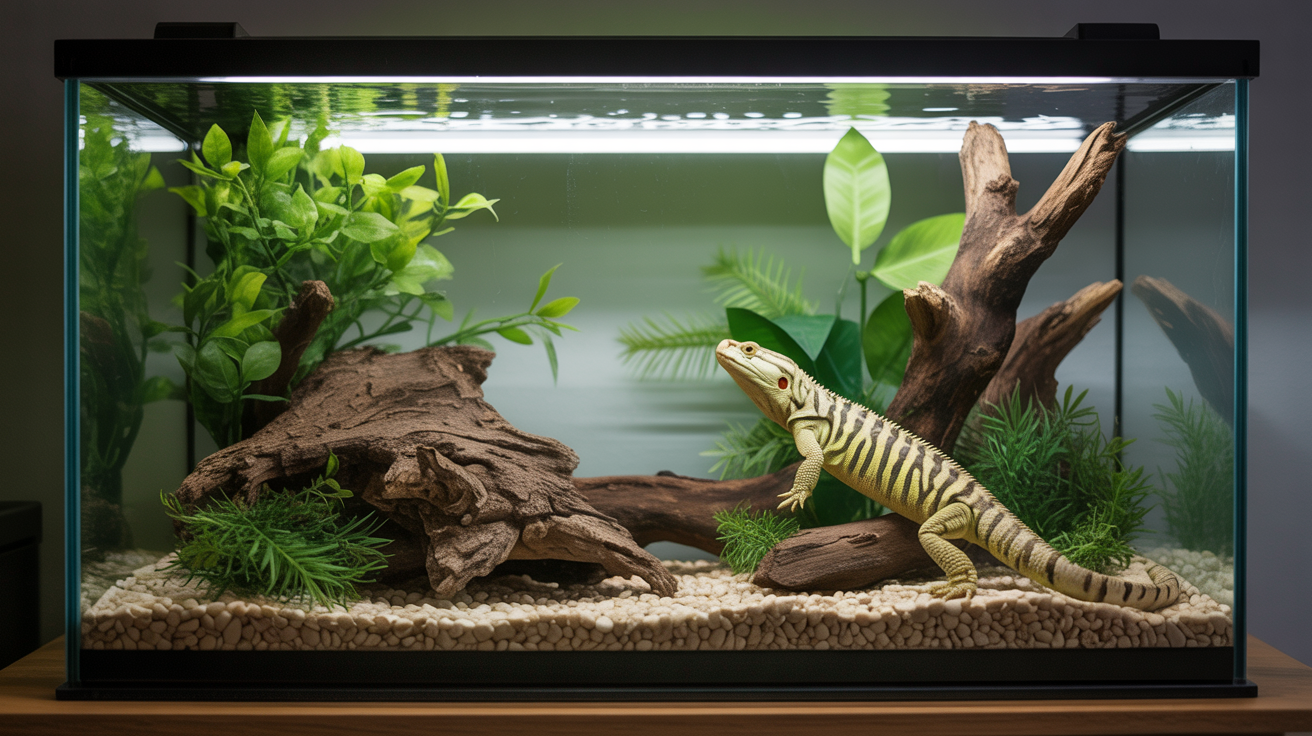
A bare glass box with a heat lamp might keep a reptile alive, but it does not give them much to work with. Reptiles use their environment actively: they wedge into tight spaces to feel secure, climb to regulate temperature, and choose surfaces that match their needs at a given moment. Decor is the part of the setup that makes those choices possible.
This guide focuses on function. The goal is a furnished tank where the heat gradient stays intact, the animal can hide, thermoregulate, and move around with confidence, and nothing in the enclosure poses a hazard. Before adding decor, it helps to have the tank size and layout sorted out. See what size tank your reptile needs and how to set up a reptile tank step by step if you are still working through those decisions.
Why Every Reptile Needs at Least Two Hides
Hides are not optional comfort items. They are the single most important piece of decor in a reptile tank.
A reptile without somewhere to retreat will spend a large portion of its time in a state of low-level stress. That stress suppresses appetite, weakens the immune response over time, and can cause animals to stop eating for weeks. A hide takes about two minutes to place and prevents most of that.
The rule is straightforward: provide one hide on the warm end of the tank and one on the cool end. This matters because a reptile that can only hide in one location is forced to choose between feeling secure and thermoregulating properly. With hides at both ends, the animal can move between temperatures throughout the day without ever having to sit in the open.
Hides should be sized so the animal fits inside snugly with their body just touching the walls. A hide that is too large does not give the same sense of security as one that fits well. Most keepers use plastic caves, cork logs, or half-log hides. All of these work. Cork bark slabs propped at an angle work well for smaller species like leopard geckos. Snakes often prefer dark, enclosed boxes rather than open half-logs.
For snakes and heavier-bodied lizards, make sure the hide cannot tip or collapse. Hides that shift when the animal pushes against them are quickly abandoned.
Basking Platforms, Branches, and Climbing Structure
Not all reptiles climb, but many more of them benefit from vertical structure than beginners expect.
Bearded dragons, blue-tongued skinks, and many monitor species are ground-dwelling, but they still use raised basking spots. A flat rock or cork platform positioned under the basking lamp gives the animal a stable place to absorb heat efficiently. Flat stones also hold heat well and can serve as secondary belly-warming surfaces after the lamp turns off.
Arboreal species like veiled chameleons, green tree pythons, and crested geckos need branches as a primary feature, not an afterthought. Without climbing structure, these animals cannot thermoregulate or behave normally. Branches should be thick enough for the animal to grip without the foot or body curling more than halfway around the diameter. Diagonal runs of branch are used more readily than perfectly horizontal ones, as they give the animal more route options.
When placing branches, keep the highest point at a safe distance from the basking lamp. A reptile that can press directly against or sit too close to the bulb can suffer thermal burns. A clearance of at least 6 to 8 inches (15 to 20 cm) from bulb to nearest perch is a reasonable starting point, though you should verify the actual surface temperature at the perch level with a temperature gun.
For a bearded dragon setup, the basking spot should read 105 to 115°F (40 to 46°C) at the platform surface, while the cool end stays around 80 to 85°F (27 to 29°C). A ball python's warm hide floor should sit at 88 to 92°F (31 to 33°C), with the cool side at 76 to 80°F (24 to 27°C). Leopard geckos do well with a warm hide temperature of 88 to 90°F (31 to 32°C) and a cool end around 72 to 75°F (22 to 24°C). Decor placement should not interfere with these gradients.
Plants, Cork Bark, and Other Decor
Cork bark is among the most versatile materials in a reptile tank. It can be used as a hide roof, a background panel, a climbing surface, or a thermal buffer on a wall. It is light, holds humidity well in tropical setups, and does not rot easily. Cork tubes work well as enclosed hides for smaller snakes and lizards.
Plants add visual cover and can help with humidity. Whether to use live or artificial depends on the species and your maintenance tolerance.
Live plants have real benefits in bioactive or higher-humidity setups. Pothos, spider plants, and bromeliads are commonly used because they tolerate the temperature ranges many tropical reptiles need and are non-toxic to most species. Live plants also contribute to a more stable microclimate in humid enclosures. The trade-off is that they require some light to survive and will eventually need trimming or replacement.
Artificial plants are easier to maintain and do not carry any risk of introducing pests or pathogens. They work well in desert setups where live plants struggle. The main thing to check is construction: avoid artificial plants with thin wire stems that could be swallowed or sharp plastic edges that might scratch skin. Soft silk or fabric foliage tends to be safer than hard plastic.
Whatever you choose, do not pack the tank so full that the animal has no open floor area. Reptiles need clear pathways between zones. Too much clutter also makes cleaning harder and can hide feces or uneaten food for long enough to cause health problems.
What to Avoid in a Reptile Tank
Several categories of decor create real risks that are worth being direct about.
Sharp or rough edges cause abrasion injuries, particularly on the undersides of snakes or the feet of lizards. Inspect any rock, resin decor, or piece of driftwood for edges that could catch skin, and sand or file down anything that feels rough.
Small loose items can be ingested during feeding. Gravel, decorative pebbles, small resin figurines, and loose substrate particles are the most common culprits. Reptiles that eat insects tend to ingest whatever is on the substrate nearby. This is one reason substrate choice matters as much as decor choice; see choosing the right substrate for your reptile for more detail.
Painted or lacquered surfaces should be avoided unless they are sold specifically as reptile-safe. Many craft paints and wood stains are toxic. Resin hides from reputable reptile suppliers are generally safe; random decorations from aquarium or craft stores may not be.
Toxic plants are a genuine concern for herbivorous and omnivorous species that may browse on foliage. Pothos and snake plants are generally considered low-risk. Dieffenbachia, philodendron, and most lily species are toxic and should not be in an enclosure with any animal that might chew on them. When in doubt, cross-check a plant against a verified reptile-safe plant list before adding it.
Finally, do not place large decor items in a way that blocks UVB lamp coverage or interrupts the temperature gradient. UVB penetration is limited, so tall decor that casts shadows over the basking zone effectively removes UVB access in that area. The animal should be able to bask where the lamp covers and also hide when it chooses, not be forced into one or the other.
If anything in your animal's tank looks wrong after furnishing, such as the animal refusing hides, spending unusual amounts of time in one corner, or showing changes in behavior, consult an exotics vet. A qualified exotics vet can rule out husbandry problems that would not be visible from the outside.
Frequently Asked Questions
How many hides does a reptile actually need? At minimum, two: one on the warm side and one on the cool side. Some keepers add a third in the middle of the tank or a humid hide (lined with damp moss) for species that need it for shedding. More hides rarely cause problems; too few cause chronic stress.
Can I use rocks and wood I find outside? You can, but they need to be cleaned and baked first. Rinse off dirt and debris, then bake rocks and dry wood at 250°F (120°C) for 30 to 60 minutes to kill bacteria, mites, and parasites. Do not use wood from cedar, pine, or other aromatic conifers, as the resins are toxic to most reptiles. Avoid rocks with sharp edges or layers that could flake off.
Will live plants survive in a reptile tank? It depends on the setup. In a tropical enclosure with adequate UVB or supplemental plant lighting, hardy species like pothos, bromeliads, and ficus often do well. In a hot, dry desert setup with a single overhead bulb, live plants will struggle and usually die within a few weeks. Artificial plants are a better fit for those environments.
Do decor items need to be secured? Anything that a larger reptile could knock over or dislodge should be secured. Rocks can be stacked and bonded with reptile-safe silicone. Heavy hides or cork tubes can be nestled into the substrate so they do not shift. The main concern is that falling decor could injure an animal sleeping underneath it.
How often should decor be cleaned? Spot-clean the tank whenever you see waste, and do a more thorough cleaning of all decor monthly or when you notice buildup. Use a reptile-safe disinfectant or a dilute bleach solution (1 part bleach to 10 parts water), rinse thoroughly, and let everything dry completely before returning it to the tank.