Habitat & Setup
How to Set Up a Temperature Gradient in a Reptile Tank
Learn how to create a proper reptile temperature gradient with a warm basking zone and cool retreat, including real temps for popular species.
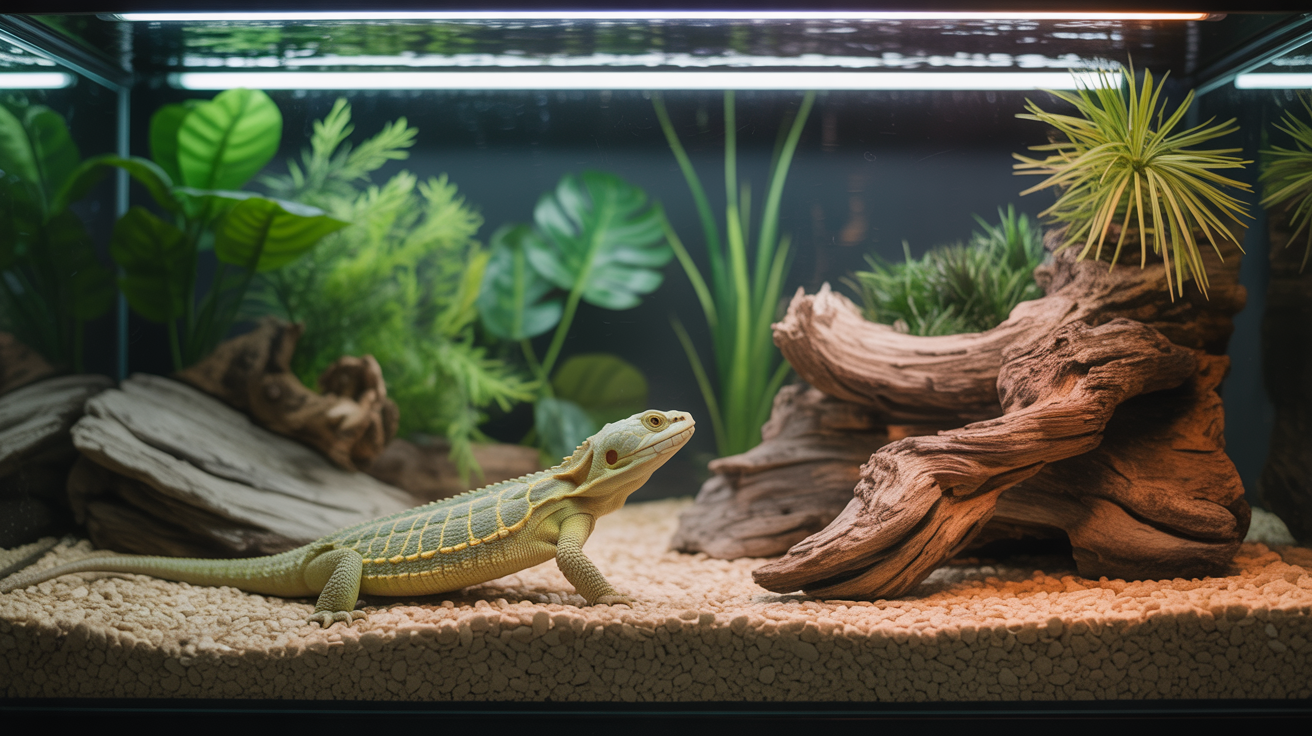
A temperature gradient is the single most important thing you can give a captive reptile. Without one, your animal cannot regulate its own body temperature, and that failure ripples into every other bodily process: digestion, immune response, activity, and mood. The good news is that setting one up is straightforward once you understand the logic behind it.
Why Reptiles Need a Choice of Temperatures
Reptiles are ectotherms. They do not generate internal body heat the way mammals do. Instead, they move between warmer and cooler areas to hit the temperature their body needs for whatever it is doing at that moment.
After eating, a bearded dragon will sit under its basking light to speed digestion. When it wants to rest or cool down, it retreats to the shaded end. That behavior is called thermoregulation, and it is instinctive. A reptile that cannot thermoregulate is like a person stuck in a room that is either too cold or too hot with no way to adjust.
In the wild, this works automatically because the sun heats one side of a rock and shade cools the other. In a terrarium, you replicate that by placing a heat source at one end only and leaving the opposite end unheated.
How to Set Up the Gradient
Put All Heat at One End
Plug your basking lamp, ceramic heat emitter, or deep heat projector into a fixture positioned directly over one corner of the enclosure. That spot becomes the basking zone. The rest of the tank receives no supplemental heat, so ambient room temperature (plus the warmth that radiates from the basking end) governs the cool side.
Do not center the heat source. Do not put a second lamp at the far end. One heat point, one end. That is what creates a gradient rather than a uniformly hot box.
Use Two Thermometers
You need a temperature reading at both ends to know whether your gradient actually exists and whether it is in the right range. One thermometer in the middle tells you almost nothing useful.
A digital thermometer with a probe works well for the basking spot surface temp. An infrared temperature gun is even more accurate for surface readings. Place a second probe or ambient gauge at the cool end, roughly at the height your animal spends most of its time (ground level for a leopard gecko, mid-height for an arboreal species).
Check both readings at different times of day, because room temperature swings can compress or widen the gradient without any change to your equipment.
Tank Size Matters for a Real Gradient
A small tank cannot hold a real gradient. If your enclosure is 12 inches long, the heat from one end fills the whole space within minutes. There is no escape.
For most terrestrial lizards, a 40-gallon breeder (36 × 18 inches) is the practical minimum for a stable warm-to-cool spread. Longer is better. A 4-foot or 5-foot enclosure gives an adult bearded dragon or blue-tongue skink enough distance that the cool end reads 15–20°F lower than the basking surface, which is exactly the kind of choice these animals need.
If you are still choosing your enclosure size, what size tank does your reptile need walks through the math for common species.
Target Temperatures by Zone
The right temperatures depend on the species. Below are common ranges for two popular beginner reptiles. Always cross-reference these with a current, species-specific care sheet.
| Zone | Bearded Dragon | Leopard Gecko |
|---|---|---|
| Basking surface | 100–110°F (38–43°C) | 88–92°F (31–33°C) |
| Warm side ambient | 85–90°F (29–32°C) | 80–85°F (27–29°C) |
| Cool side ambient | 75–80°F (24–27°C) | 70–75°F (21–24°C) |
Basking surface temperature is measured directly on the surface where the animal sits, not at thermometer height. An infrared gun gives the most accurate reading for this.
Night Temperatures
Most reptiles tolerate, or even prefer, a temperature drop at night. Bearded dragons in the wild experience nighttime lows in the 60s°F (15–20°C). In most homes, simply turning off the basking lamp at the end of the photoperiod is enough to achieve this, as long as ambient room temperature stays above 60–65°F (15–18°C).
If your home drops below that range in winter, a ceramic heat emitter (which produces no light) or a low-wattage radiant heat panel can maintain a safe floor temperature without disrupting the dark cycle. Do not use red or blue "night bulbs" to maintain heat. Research has shown that reptiles can perceive these wavelengths, so they disrupt sleep.
Avoid covering the enclosure tightly at night to "hold heat." That traps humidity and can also compress the gradient so there is no cooler area for the animal to use even if it wants one.
Choosing the Right Equipment
Basking Lamps
For diurnal (day-active) species like bearded dragons, green anoles, or crested geckos, a simple incandescent bulb or halogen flood produces both light and heat. Wattage determines temperature, so start with a lower-wattage bulb and adjust rather than buying the most powerful option and trying to dial it back with the lamp height.
Deep Heat Projectors and Ceramic Emitters
These are infrared heat sources that produce no visible light. Deep heat projectors penetrate deeper into muscle tissue and are well-suited to thermoregulation. Ceramic emitters produce surface heat with no light output, making them appropriate as nighttime backup heaters. Neither should replace a proper basking lamp for diurnal species that need UVB and a bright photoperiod.
What to Avoid
Undertank heating mats marketed as primary heat sources are poorly suited to most lizards and snakes because they heat from below rather than above. Reptiles typically read heat from above (where the sun would be). If you use a heat mat for a snake that needs belly warmth, keep it on one side only, cover it with appropriate substrate, and always use a thermostat. Without a thermostat, heat mats can cause thermal burns through the substrate.
Appropriate substrate also plays a role in how well a gradient holds. Dense, tight substrates like compressed coconut fiber retain heat differently than loose particle substrates, and that affects where temperature pockets form. Choosing the right substrate for your reptile covers the tradeoffs.
Putting It Together
Start your setup before your animal arrives. Run the lights for 24 hours, take readings at both ends at morning, midday, and evening, and adjust lamp wattage or height until your readings land in the target range for your species. Only then introduce your reptile.
A good gradient is stable. If you find yourself constantly fiddling with lamp position because the temperatures are inconsistent, suspect room temperature variation, a poorly sealed enclosure letting heat escape, or a lamp that is simply underpowered for your ambient conditions.
For a full walkthrough of the physical setup, including screen lid placement and lamp fixture safety, see how to set up a reptile tank: a step-by-step guide.
Frequently Asked Questions
How do I know if my temperature gradient is working?
Check surface temperature at the basking spot (with an infrared gun or probe thermometer) and ambient temperature at the cool end. There should be at least a 15°F (8°C) difference between the two zones, ideally more. If the cool end is nearly as warm as the basking end, your enclosure is too small or you have too many heat sources.
Can I use one thermometer in the middle?
A single mid-tank reading tells you the midpoint temperature, not whether a gradient actually exists. You need both ends. A mid-tank reading of 82°F could mean you have a 95°F basking zone and a 70°F cool side, or it could mean the whole tank is uniformly 82°F. Those are very different situations for your reptile.
Does my reptile need UVB, or is heat enough?
For most diurnal reptiles, UVB is essential for synthesizing vitamin D3, which enables calcium absorption. Heat and UVB are separate requirements. A basking lamp provides heat; a UVB bulb (or a combined mercury vapor bulb) provides the ultraviolet radiation. Nocturnal species like leopard geckos have reduced UVB needs, but current research suggests some low-level UVB is still beneficial even for them.
What happens if I turn off all the lights at night?
In most home environments, turning off the lamps at night is fine and actually mimics the natural temperature cycle. As long as ambient room temperature stays above 60–65°F (15–18°C), most common reptiles handle the drop without issue. Some species from tropical environments need a warmer floor (around 70°F / 21°C), so check the specific requirements for your animal.
My reptile only uses the cool side. Should I raise the basking temperature?
Not automatically. First check that your basking surface temperature is accurate with an infrared gun. Visible heat sources sometimes feel hotter to us than they measure. If the basking temperature is already at the high end of the target range, the animal may simply prefer to stay cool for now, or it may indicate stress from handling, an illness, or environmental factors worth investigating. Raising the temperature higher than the species-appropriate range is not the answer.